
De-Dollarization? Not So Fast
You won't find much evidence for de-dollarization, but you will find colorful visuals.

The is short review of a few charts that Macrobond published on Friday which focus on the state of the U.S. dollar and it’s position as a reserve currency. If you want a deeper dive on why the dollar is here to stay despite all the headwinds, check out my more thorough piece from last year. The data below is more up-to-date, but the thesis hasn’t changed.
Why the Dollar Still Dominates Global Finance

The recent “Sell America” narrative suggests that the U.S. financial system, and the dollar’s role as the world’s primary reserve currency, is at risk. Rising geopolitical tension between the U.S. and Europe (and others), questions about Federal Reserve independence, and growing U.S. government debt have fueled mounting concern. But discomfort with U.S.…
Chart 1: DXY Dollar Index Trends
The structural bear case for the US dollar still lacks meaningful supporting evidence. The dollar’s cyclical downtrend since its 2022 peak is minor compared to historical selloffs. The current trend lacks the momentum of the prior two major declines, supporting the thesis that this is not a breakaway shift in confidence.
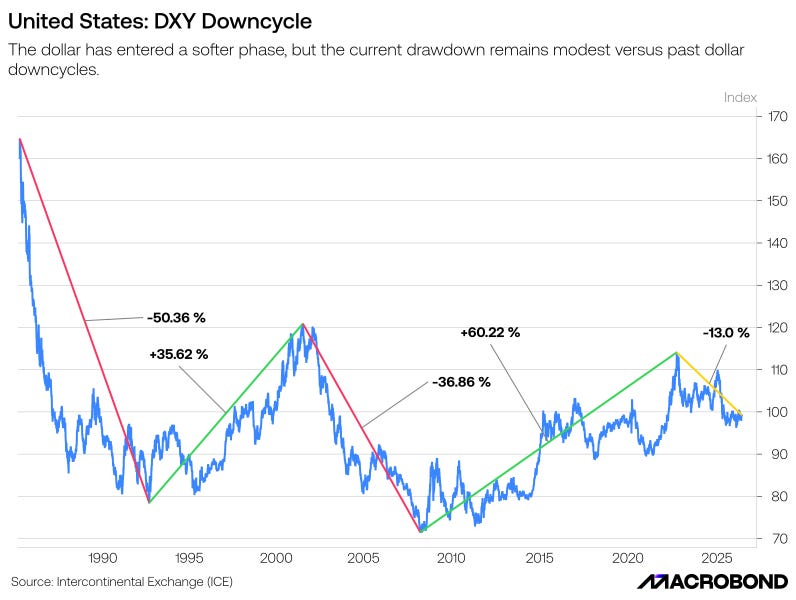
Chart 2: DXY Fair Value
DXY valuation models show the dollar has digested the geopolitical and fiscal risks that pushed the index down following the announcement of new tariffs in 2025. The discount that developed has closed, and the spot DXY now trades at or slightly above its assumed fair value.
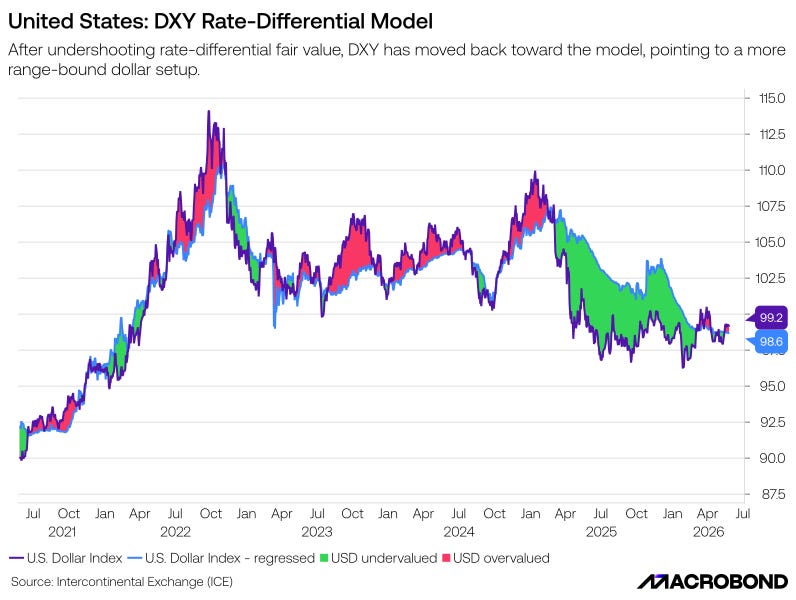
Chart 3: Rate Hike Risks
Current monetary policy in the US, Eurozone, and UK remains below the levels suggested by the Taylor-rule1.
When major reserve currencies suffer from a lack of monetary policy credibility, relative advantages can determine capital flows. The dollar wins this competition. The spot DXY has erased its previous discount and now trades near model fair value.
Higher economic growth in the US offers better economic insulation against inflation and gives the Federal Reserve more room to maneuver than the UK or EU central banks. Although the rapidly growing US debt is a major risk if investors fear a debt spiral or financial repression.
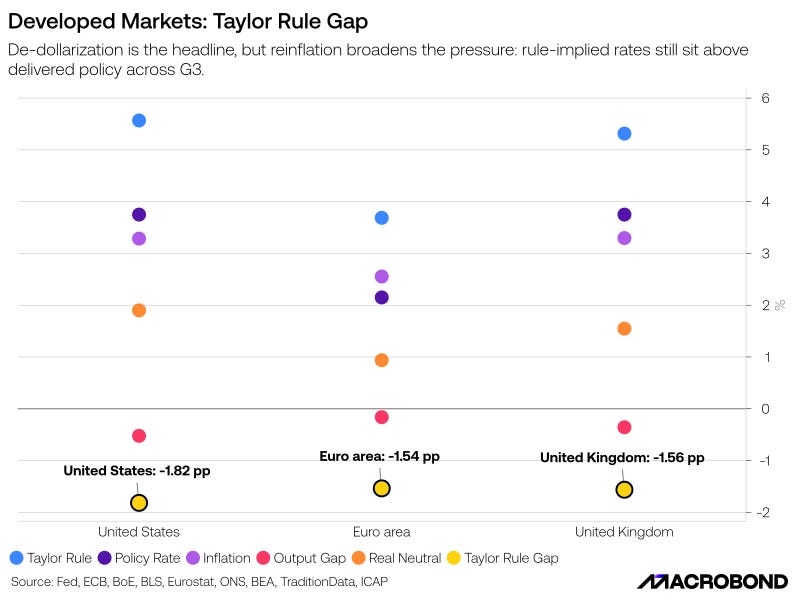
Chart 4: Reserve Currency Competition
The latest IMF COFER2 data shows the dollar’s share of allocated global reserves drifted down to 56.8% in the final quarter of 2025. This decline is a continuation of a long-term trend and the foundation for much of the bearish sentiment surrounding the dollar. However, the key detail is that currency reserves are being diversified across smaller alternative currencies rather than concentrated toward a single rival like the Chinese renminbi or the euro.
Capital exiting the dollar is scattering across minor alternatives instead of consolidating behind a single challenger. The euro remains the primary reserve alternative, but energy-driven inflation forces a costly trade-off for the European Central Bank: hike rates to fight inflation and suppress growth, or accept a weaker currency.
With growth in the Eurozone already weak, it’s a devil’s bargain.
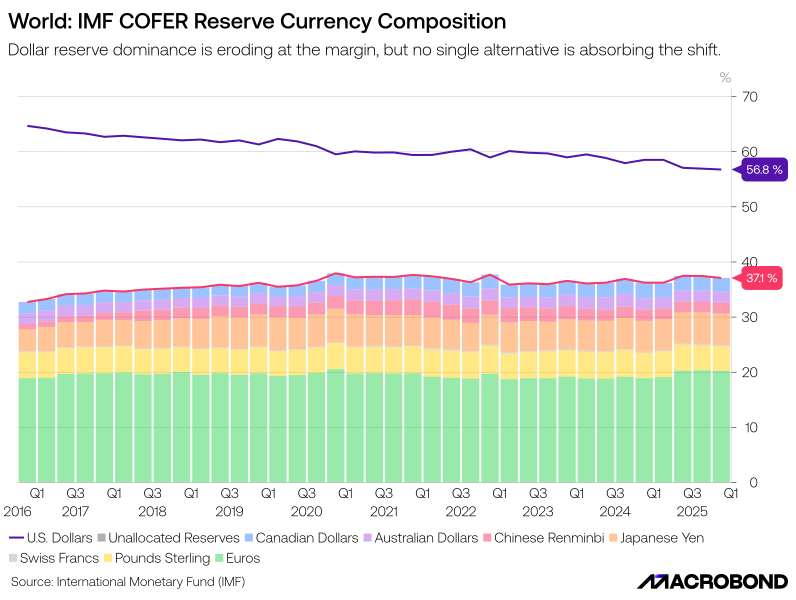
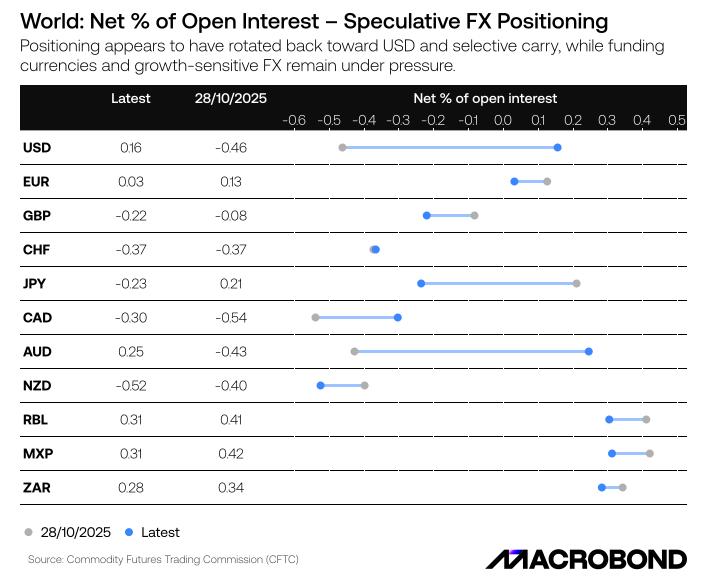
Chart 5: Come Home to the Dollar(s)
Speculative positions confirm investors reluctance to flee the US dollar. Since October, investors have moved from a net-short to a net-long position, with the Australian dollar the only other major currency to see similar results.
De-dollarization remains a talking point rather than a trading strategy, even in today’s tense geopolitical environment.
In Summary
The slowly fragmenting currency reserves market isn’t causing an exodus from the US financial system, in part because US equity markets still offer substantial returns to investors on a relative basis.
Currency diversification may reduce dollar demand at the margin, but it doesn’t automatically create a replacement system capable of competing with the dollar. A viable global reserve currency requires deep liquidity, unmatched capital markets, and a strong business and regulatory environment.
Until a single rival pairs those traits, the dollar will remain the uncontested anchor of global finance. Nothing in the current shifts in the global monetary system points to the abandonment of the dollar.
Thanks for reading—Stephen
Disclosures
Content contained within this publication, which contains security-related opinions and/or information, is provided for informational and educational purposes only and should not be relied upon in any manner as professional advice, or an endorsement of any practices, products, or services. There can be no guarantees or assurances that the views expressed here will be applicable for any particular facts or circumstances, and should not be relied upon to make personal investment decisions. You should consult your own advisers as to legal, business, tax, and other related matters concerning any investment.
The commentary in this newsletter (including any related blog, podcasts, videos, and social media) reflects the personal opinions, viewpoints, and analyses of Stephen Kates, Advance \ Decline, and Clocktower Financial Consulting, LLC and should not be regarded as the views of any other individual, entity, company, or its respective affiliates. References to any securities or digital assets, or performance data, are for illustrative purposes only and do not constitute an investment recommendation or offer to provide investment advisory services. Investing in speculative securities involves the risk of loss. Nothing on this website should be construed as, and may not be used in connection with, an offer to sell, or a solicitation of an offer to buy or hold, an interest in any security or investment product.
Charts and graphs provided within are for informational purposes only and should not be relied upon when making any investment decision. Past performance is not indicative of future results. The content speaks only as of the date indicated. Any projections, estimates, forecasts, targets, prospects, and/or opinions expressed in these materials are subject to change without notice and may differ or be contrary to opinions expressed by others.
The Taylor Rule provides a guideline for how central banks (like the Federal Reserve) should adjust short-term interest rates in response to inflation and economic growth. The rule oversimplifies the inputs for rate policy decisions which is why central banks do not follow it strictly.
IMF = International Monetary Fund; COFER = Currency Composition of Official Foreign Exchange Reserves